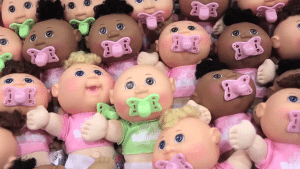


Every so often, a toymaker captures lightning in a bottle that ends up exploding into a magnificent and volatile storm of fervor. But the Cabbage Patch riots remain unique even in a long and ever-growing list of toy crazes, so infamous it remains the definitive benchmark to this day. A few elements had to line up perfectly to make these the toy to have—so much so that people would risk life and limb—and part of that perfect, dangerous storm began in what used to be a clinic.
It was 40 years ago that the Cabbage Patch riots kicked off in earnest, characterized by several violent outbursts in stores across the U.S. during the fall and winter shopping season of 1983. Major outlets like Macy’s, J. C. Penney, Sears, and Wards had to contend with mobs. Smaller retailers quickly brainstormed methods of crowd control involving purchase tickets, as hundreds—even thousands—of customers descended, sometimes armed with weapons. Not just any toy has inspired this kind of aggression, so how did a few simple design choices made in the ‘70s, along with retail policies from a Georgia toy shop, set the stage for popularity… and disaster?
Cabbage Patch Kids were the children of a Georgia native

The story of these adorable kids began with Xavier Roberts, a native of Cleveland, Georgia, who got his start in brainstorming and crafting dolls in 1976, when he met folk artist Martha Nelson Thomas at a craft fair. Thomas frequently worked to create what are called “soft sculptures,” and she eventually established a product line called Doll Babies. Roberts asked Thomas to supply him with dolls he could sell in Georgia.
RELATED: Cabbage Patch Kids: The Facts About Them Are Too Strange to Make Up
For a brief time, this alliance flourished. Thomas allowed him to sell her Doll Babies, but eventually stopped and actually sued Roberts. The two settled out of court, with Thomas winning an undisclosed amount. Roberts then took the Doll Babies idea and created his own version in 1978. They were partially an offshoot of what Thomas had made and partly inspired by crafting techniques dating back to 1800s Germany. These Roberts christened Little People.
Maintaining this business momentum, Roberts then partnered with one of the biggest toy companies at the time, Coleco, to officially license his soft sculptures. Between mass production with such a giant company and his own decision to personally travel from state to state promoting this new product, America couldn’t overlook these toys that became the Cabbage Patch Kids.
But there was one more seemingly quaint choice made that would transform these dolls from sweet kids to the force behind riots around the country—and the biggest holiday shopping day in America.
A former clinic ended up playing a part in inspiring the Cabbage Patch riots
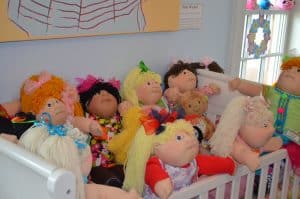
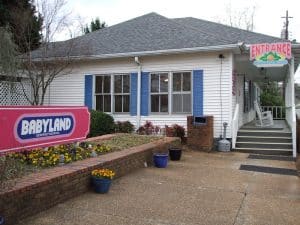
Ever the businessman, Roberts made another crucial decision. He oversaw the construction of a retail facility located in what used to be a clinic, right in his native Cleveland, Georgia. Already gaining popularity and enjoying an unprecedented spotlight decades before going viral was even a concept, the Cabbage Patch Kids received a new, creative stage upon which to shine thanks to the opening of the BabyLand General Hospital.
The budding lore of the Cabbage Patch Kids named the BabyLand General Hospital as the “birthplace” of the Cabbage Patch Kids and fully committed to this story with amenities featuring the birthing, nursery, and adoption of premium Cabbage Patch Kids. Now, this growing fad had its own pilgrimage site for followers. This sense of purposeful travel would carry over well when the Cabbage Patch Kids hit other retailers’ shelves for the holiday season of ‘82, which is when mass production of them began in earnest.
Its production wasn’t quite massive enough, however.
Their popularity outpaced supply, especially after the dolls appeared at the International Toy Fair of New York City. There were even adoption events hosted around the country. A timely Newsweek cover featuring the soft sculptures reached everyone else who couldn’t make those events. All the while, the dolls rose to prominence in an era when the Atari and Walkman gadgets were shouldering their way into the spotlight, notes Mental Floss; in this way, the Cabbage Patch Kids were a beacon of simple wholesomeness. Advertising teams knew this and made sure adults knew too by targeting parents looking for a good, dependable holiday gift for the little ones—with no technology in sight.
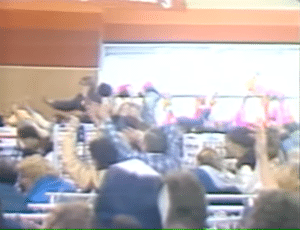
The stage was set, and in rolled the 1983 shopping season. The Cabbage Patch riots set such a frantic precedent that they ultimately inspired hectic Black Friday shopping to this day. In fact, Black Friday itself traces its roots right into the same soil as these dolls.
Other successors would rekindle memories of the Cabbage Patch riots, but in 40 years since the original craze, even Beanie Babies and Tickle Me Elmo never came as close to the same levels of outright violence. Perhaps that’s because of the emphasis on just how unique each and every Cabbage Patch Kid was and how unique that would make each family feel. Computer programs randomized the combination of features so no two dolls would be alike—except all of them would have adoption papers acting like a cute, empowering certificate of authenticity signed by the very child who would love it forever.
What are your memories of the Cabbage Patch riots?