

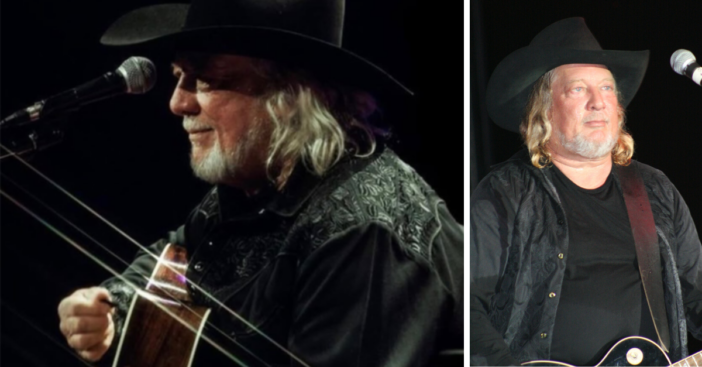
- Country singer John Anderson died Oct. 21, 2026, at his home in Smithville, Tennessee. He was 71.
- Anderson was known for hits including “Swingin’,” “Wild and Blue,” “Straight Tequila Night” and “Seminole Wind,” and was inducted into the Country Music Hall of Fame in 2024.
- His final public appearance came just three days before his death, when he attended the 2026 Country Music Hall of Fame Medallion Ceremony in Nashville.
John Anderson, the Florida-raised singer whose voice carried “Swingin’,” “Wild and Blue” and “Seminole Wind” across country radio, died Wednesday, October 21, 2026, at his home in Smithville, Tennessee. He was 71. His family shared the news in a statement on his official Facebook page, as Fox News reported. According to Billboard, he died peacefully in his sleep. No cause of death has been announced.
“It is with the heaviest of hearts that we share the passing of our beloved husband, father, grandfather, and best friend,” the family wrote. “To the world, he was a gifted country music singer whose voice and songs touched countless lives. To us, he was so much more.” What made the news land so hard in Nashville was where Anderson had been only three days earlier, and who he had been standing with.
How Did a Boy From Apopka Get to the Opry?

Anderson grew up in Apopka, Florida, loving rock and roll until George Jones and Merle Haggard pulled him toward country. He described himself at his Hall of Fame induction as “an old boy who took off from his hometown with a guitar and $40,” and the Country Music Hall of Fame recalls that during his lean years he took odd jobs, including roofing work on the new Grand Ole Opry House, before the stage inside it was ever his.
Warner Bros. Records eventually signed him, and his self-titled debut album arrived in 1980. His first big hit was Billy Joe Shaver’s “I’m Just an Old Chunk of Coal (But I’m Gonna Be a Diamond Someday),” and that weathered, old-school voice helped steer country radio back toward its roots.
Then came the porch swing.
Why Did “Swingin'” Become the Song Everyone Knew?
View this post on Instagram
Anderson wrote “Swingin'” with his old friend Lionel Delmore, the son of Grand Ole Opry pioneer Alton Delmore of the Delmore Brothers. The song tells the story of a fellow sitting on the front porch swing with a girl named Charlotte, and if you had a radio in 1983, you can probably still sing it. It went to No. 1 on the country chart and crossed over to the Billboard Hot 100, peaking at No. 43, according to Billboard. It has long been described as the biggest-selling single in the history of Warner Bros. Records.
The Country Music Association named it Single of the Year in 1983, and Anderson took home the CMA Horizon Award that same year, Fox News reported. “Wild and Blue” had gone to No. 1 just before it. By the end of his career Anderson had 20 Top 10 country hits and five No. 1 singles, according to the Country Music Hall of Fame.
The hits slowed in the late 1980s, but in 1992 he signed with BNA Records and answered with the album Seminole Wind. “Straight Tequila Night” went to No. 1, and the title song, his mournful plea for the Florida Everglades he had known as a boy, climbed to No. 2. “Money in the Bank” followed, and a new generation learned his name. Through it all he and his wife, Jamie, married since 1983, raised their two daughters in Smithville, well away from Music Row.
What Did He Lose, and What Did He Win Back?
In 2017 Anderson canceled an Alabama festival date over what his representatives called “unforeseen and serious medical issues.” He later told Taste of Country that he spent most of 2017 and much of 2018 gravely ill, and that doctors had feared a brain tumor that turned out to be benign. Heart trouble was part of that ordeal too.
The cruelest blow for a singer was his hearing. Anderson lost most of it, and he told Nashville’s WPLN earlier this year that “it was really dire straits for me” and “a very very dark and depressing time in my life.” His Vanderbilt doctor, David Haynes, told the station they “were on a timeline” to save it.
Enough of it came back. “I did a whole lot of praying, and the good Lord saw fit to it that I get better,” Anderson told Taste of Country. Dan Auerbach of the Black Keys brought him into his Easy Eye Sound studio, and their album Years, released in April 2020, was his last.
He never forgot the doctors. Anderson kept offering to play a benefit until it happened, and on February 6, 2026, he walked onto the Ryman Auditorium stage for an acoustic evening that raised money for Vanderbilt Health’s hearing and music therapy programs. Haynes called it “extremely generous.”
Where Was John Anderson Three Days Before He Died?
View this post on Instagram
On October 20, 2024, Anderson became the 153rd member of the Country Music Hall of Fame, inducted alongside Toby Keith and James Burton. Songwriter Bobby Braddock presented his medallion and called him “my country hero,” and Anderson told the crowd, “The honors here this evening are just about overwhelming for me.” Then he closed with a line that reads differently now: “I hope I never have to quit.”
He didn’t. On Sunday, October 18, 2026, Anderson walked into the CMA Theater in Nashville with his fellow Hall of Fame members for the Class of 2026 Medallion Ceremony, according to Country Now, and he watched Tim McGraw, songwriter Paul Overstreet and the Stanley Brothers join him as members. McGraw shared afterward that he had talked with Anderson that night and found him in good spirits, Billboard reported. It turned out to be his final public appearance.
Three days later he was gone. Kyle Young, CEO of the Country Music Hall of Fame and Museum, said goodbye by reaching back to that first hit about an old chunk of coal. “He was already a diamond then,” Young said, “and a diamond he always will be.”
His family had the last word. “His music will live on,” they wrote, “but for us, his greatest legacy will always be the love he gave his family and the memories we will carry with us forever.”