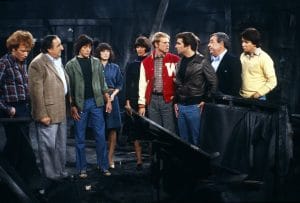


For two seasons, the Cunninghams of Milwaukee had three children. Everybody remembers Richie and Joanie, but there was also Chuck Cunningham, the basketball-playing older brother who was about to head off to college. Then, in the middle of Happy Days‘ second season, he was gone, with no farewell episode, no phone call home and no explanation.
Nothing happened to Chuck inside the story, because the story never noticed he had left. He was written out on purpose. The actor who first played him asked to leave, his replacement lasted two episodes, and creator Garry Marshall decided Richie already had a big brother in the Fonz. So Chuck vanished, and the show never looked back.
Over its long run on ABC, from 1974 to 1984, Happy Days went through three different Chucks, all playing the eldest child of Howard and Marion. Ric Carrott had the part in the 1972 pilot, Gavan O’Herlihy took it in season 1, and Randolph Roberts followed in season 2.
Viewers saw Chuck for the last time in “Guess Who’s Coming to Christmas,” which aired December 17, 1974. His quiet exit left something behind, though: a nickname. “Chuck Cunningham syndrome” now describes TV characters who disappear without a word.
Who Was Chuck Cunningham?

Chuck was around before Happy Days even existed. The show grew out of “Love and the Happy Days,” a 1972 segment of the anthology series Love, American Style, and Ric Carrott played Chuck in that pilot. When the series launched in January 1974, Gavan O’Herlihy took over the part.
Even then, Chuck was never a big part of the stories. According to Looper, O’Herlihy is credited in nine season 1 episodes but appears on screen in only seven of them, and Chuck mostly passed through scenes on his way to basketball practice or a date.
When season 2 began, Randolph Roberts stepped into the role, and he played Chuck in just two episodes. His final appearance came in that Christmas episode on December 17, 1974, and after that, Chuck never appeared again.
Why the First Chuck Walked Away
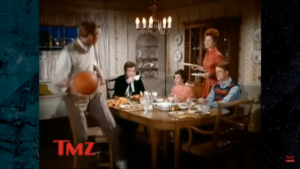
O’Herlihy left by choice. In a 2013 interview with OnMilwaukee, later quoted by Mental Floss, he explained that he hung around for the first half-season and then asked out of the contract, because the job, as he put it, “wasn’t my cup of tea.”
He was in his early twenties and could see exactly where the role was heading. “I was going to grunt and bounce a basketball once every couple of weeks for probably three or four years,” he said. What he wanted was a film career, and he went out and built one, with roles in Superman III and the James Bond film Never Say Never Again. Years later, Ron Howard directed him as the warrior Airk in Willow (1988).
Garry Marshall remembered the exit a little differently. According to TheWrap and Showbiz Cheat Sheet, Marshall said the first Chuck wanted to quit and go back to school to become a poet.
What Garry Marshall Said About Chuck’s Disappearance
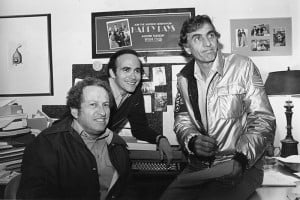
Marshall, who died in July 2016 at 81, talked about Chuck at a May 2016 panel just a few weeks before his death. Viewers, he explained, had come to see Fonzie as Richie’s real older brother, and the writers found that relationship worked better, according to Mental Floss and Showbiz Cheat Sheet. When you think about it, Arthur Fonzarelli was already doing everything a big brother does, giving Richie advice, backing him up and taking him down a peg when he needed it.
So Marshall tried an experiment. “So I just said, let’s just have Chuck disappear, and let’s see how much mail we get,” he recalled, according to TheWrap. The answer came back fast. “We didn’t get much.”
The cast, on the other hand, never let it go. Marshall said that for years afterward, any confusion on the set turned into a running joke: “Was that Chuck? Who’s on the phone? Is that Chuck?”
Making a son vanish was a bold call for a family sitcom, though hardly a unique one, and fans have seen similar behind-the-scenes decisions with other actors who suddenly left their TV shows.
What the Show Actually Says
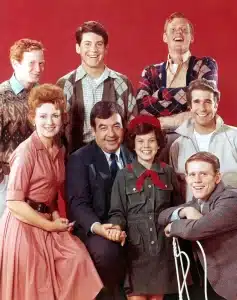
On screen, Happy Days offered no explanation at all. The last viewers heard, Chuck was away at college, and then the family stopped mentioning him.
The strangest moment came at the very end. In the series finale, Joanie marries Chachi, and Howard Cunningham raises a toast that speaks of the couple’s children as if there had only ever been two. Mental Floss and Looper both point to that moment as the show’s quiet admission that Chuck had been erased. Accounts differ on the exact wording of Tom Bosley’s line, but to anyone counting at home, the meaning is clear.
Even when Ron Howard left the series in 1980, the oldest son stayed gone. Rather than calling him home, the show filled the house with Richie’s cousin Roger, played by Ted McGinley.
The Fan Theories, and the Name That Stuck
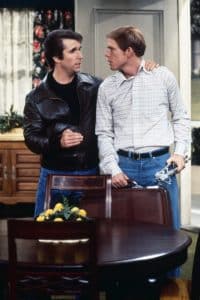
Since the show never answered the question, fans have answered it for themselves, though none of their theories are canon. The most common one holds that Chuck stayed away after college and built a life far from Milwaukee, while another reads the finale toast as a sign the family stopped talking about him for reasons of its own. Nothing in any episode supports either idea, and the creators never hinted at one.
What the disappearance did leave was a mark on television itself. Writers and fans now use the phrase “Chuck Cunningham syndrome” for a character who vanishes from a series without an in-story reason and is never mentioned again, and TheWrap and Mental Floss both credit Happy Days as the source of the term. It sits right beside “jumping the shark,” another phrase the same show handed to the language.
Gavan O’Herlihy died on September 15, 2021, in Bath, England, at 70. His family did not share a cause, and his death was announced that November. Ron Howard, once his little brother on screen, remembered him on Twitter. “RIP Gavan,” Howard wrote, recalling him as the first of two Chucks and as Airk in Willow, and he called him “a talented actor with a big free spirit,” according to CNN via WFTV.
Chuck never got his goodbye scene. But the young man who first played him walked away to find the work he wanted, and he found it, which may be the best farewell the character could have had.