

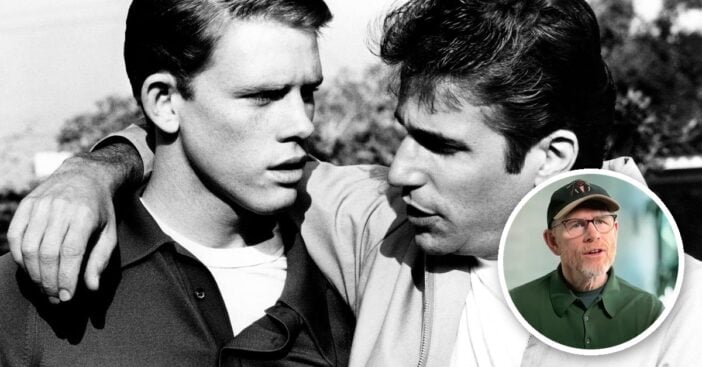
By the late 1970s, Ron Howard couldn’t go to the mall without being recognized. Happy Days had turned Richie Cunningham into one of the most familiar faces on television, and Howard, now 72, admitted this month that he took to wearing a disguise when he went out in public. “If you wanted to go to a mall or go to Disneyland or go out to the movies even, you had to lay low,” he said at the Hamptons International Film Festival, as Entertainment Weekly.
Howard was in East Hampton for a conversation at Guild Hall on October 10, the same day his new documentary Avedon, about the fashion photographer Richard Avedon, had its East Coast premiere. The look he chose to hide in was about as far from Milwaukee’s nicest boy as he could get. To see why he needed it at all, you have to go back to a little boy in Mayberry.
How Did Opie Taylor Grow Up To Be Richie Cunningham?

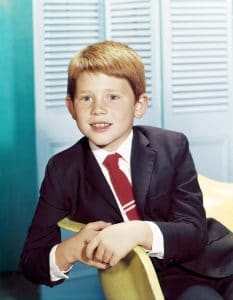
Howard was born March 1, 1954, in Duncan, Oklahoma, to actors Rance and Jean Howard, and he was six when The Andy Griffith Show premiered in 1960. As Opie Taylor, the freckled son of Sheriff Andy Taylor, he appeared in all eight seasons through 1968. His little brother Clint, now 67, turned up in Mayberry too, as Leon, the tiny cowboy forever offering someone a bite of his peanut butter and jelly sandwich. Mayberry kept some of its own secrets, including what happened to Opie’s mother.
The teenage years brought a second big break. In 1973, he played Steve Bolander in George Lucas’s American Graffiti, which earned $55 million and was the third biggest film of the year. Its 1950s mood fit the show ABC launched in January 1974, and Howard became Richie, the wholesome Jefferson High student with the red hair and the good manners. He married his high school sweetheart, Cheryl Alley, on June 7, 1975, right in the middle of it all. Then a guy in a leather jacket started taking over the show.
Why Did ‘Happy Days’ Fame Wear On Ron Howard?
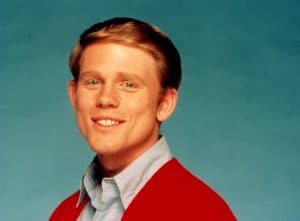
Howard has been honest that the show’s success came at a price. “The biggest stressor of all was Fonzie. Not Henry [Winkler], but Fonzie,” he wrote in The Boys: A Memoir of Hollywood and Family, the 2021 book he wrote with Clint, as excerpted by the New York Post. “It did not escape my notice that as the season went on, the Fonz was getting more and more screen time.”
His body kept score. “Then I started breaking out in eczema rashes all over my body,” he wrote, and his hair “started coming out in alarming clumps during this time.” He admitted, “I didn’t handle my stress particularly well. I probably would have benefited from seeing a psychotherapist.” When the network floated retitling the show Fonzie’s Happy Days, he made clear he would walk. “I would rather go back to USC and film school and what I was doing before the show launched,” he recalled, according to Fox News. Garry Marshall kept the title, and he kept a few house rules too, like the fact that the whole cast had to share one bathroom.
The fan frenzy pushed him in a new direction. It “was another thing that pushed me to want to get behind the camera,” Howard told Entertainment Weekly. And he had already found a back door into directing.
What Did Ron Howard Do After Leaving ‘Happy Days’?
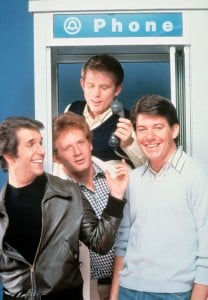
While still playing Richie, Howard made a deal with low-budget producer Roger Corman. He starred in Corman’s 1976 car chase picture Eat My Dust!, and in return he got to direct Grand Theft Auto in 1977, a script he wrote with his father, Rance. In 1980, just before the eighth season, he left Happy Days for good.
His old co-star helped him get started. Henry Winkler signed on to Night Shift (1982), the comedy that gave Michael Keaton his breakout film role. “When Henry said yes to Night Shift, that’s what got that movie greenlit,” Howard told People in 2025. “He played a hand in helping my dream ultimately come true, which was to be a studio, Hollywood, feature director.”
The hits came fast after that. Splash (1984) made a star of Tom Hanks, and Cocoon (1985) won Don Ameche an Oscar. Apollo 13 (1995) earned nine Academy Award nominations, including Best Picture, and A Beautiful Mind won Howard the Oscar for Best Director in March 2002, along with Best Picture. Younger viewers know his voice as the narrator of Arrested Development, and this year he took Avedon to the Cannes Film Festival ahead of its Netflix release. Through all of it, the memory of hiding from fans in a mall stayed with him.
What Did Ron Howard’s Disguise Actually Look Like?
“It did get to the point, the show was so popular that you’d sort of have to wear little disguises and things,” Howard told the Hamptons audience. Since Richie was the clean-cut kid next door, Howard went the opposite way.
“I had kind of a leather jacket that was tough. Not a Fonzie leather jacket, but this ’50s motorcycle cop kind of thing,” he said. “And I would let my hair grow out a little bit and what I could grow of a mustache or something like that and wear shades.”
The goal was simple enough. “I tried to look tough,” he said. “My disguise was simply to try to be a little bit tough.”
So the most famous good boy on television slipped into theaters in shades and a leather jacket, careful to make sure it looked nothing like the one the Fonz wore. Nearly half a century later, Howard still marvels at how far that show has traveled. “There’s something about that that doesn’t age,” he once told People. “It was nostalgia when it was made.”