

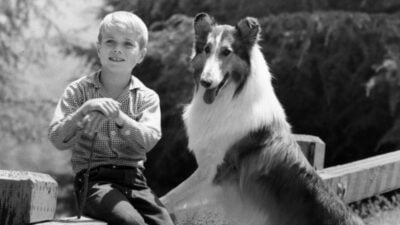
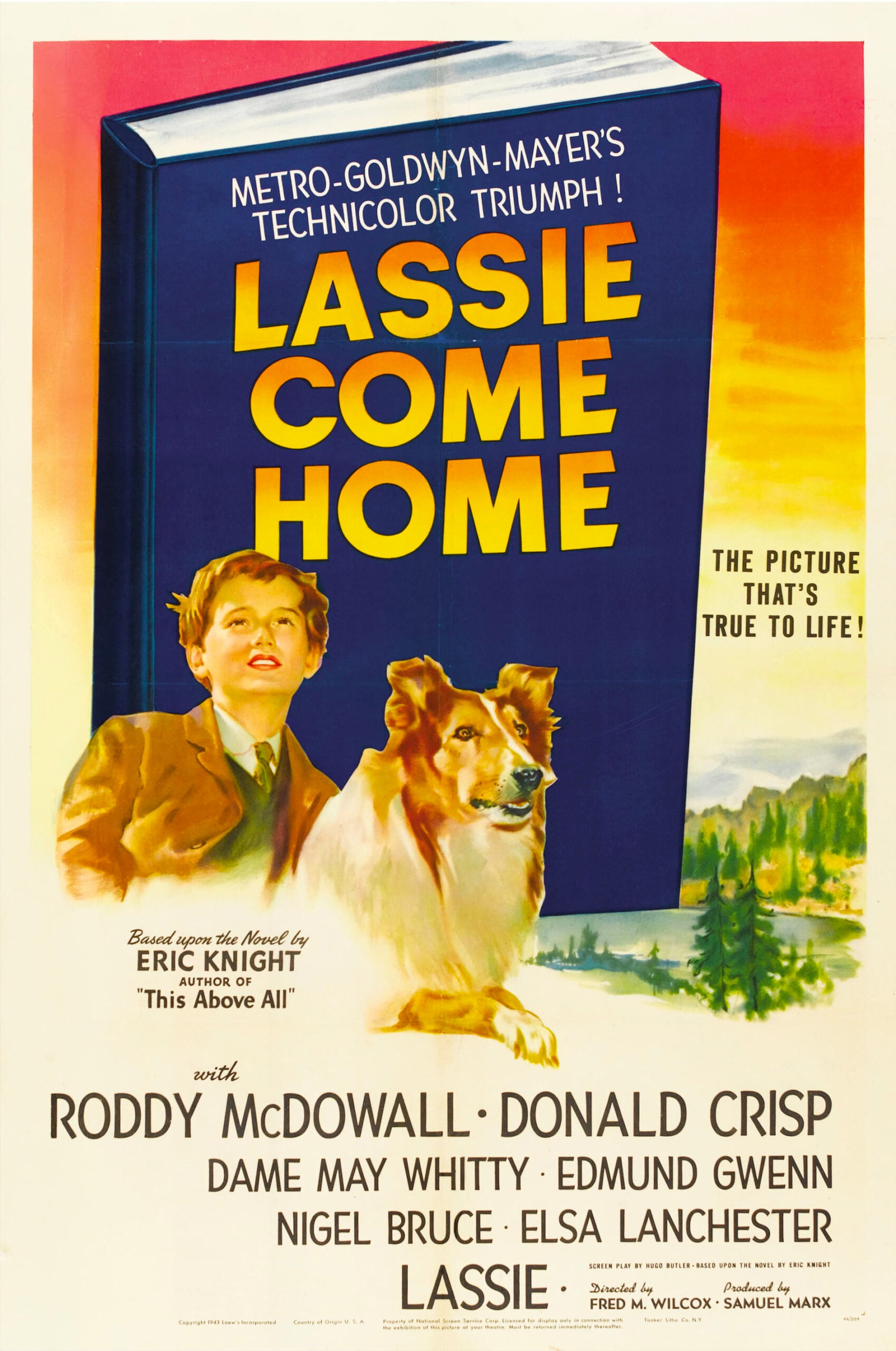
Eric Knight never left any doubt. When his short story about a Yorkshire collie walking hundreds of miles home to her boy ran in The Saturday Evening Post in December 1938, and again when he expanded it into the 1940 novel Lassie Come-Home, Lassie was a she. MGM kept her that way in the 1943 film, and so did the CBS series Lassie, which premiered in September 1954 and ran 19 seasons, the last two in syndication, before it signed off in March 1973. Every “good girl” Timmy ever said was written for a female dog.
The dogs who heard those words were another story. Every collie who played Lassie for trainer Rudd Weatherwax was a male, beginning with a dog named Pal, and his sons and grandsons carried the role through the whole TV run. How a scruffy male stunt dog took a girl’s part, and why Weatherwax never handed it to a female afterward, comes down to one river crossing and a lot of fur.
How Did A Boy Named Pal Win A Girl’s Role?
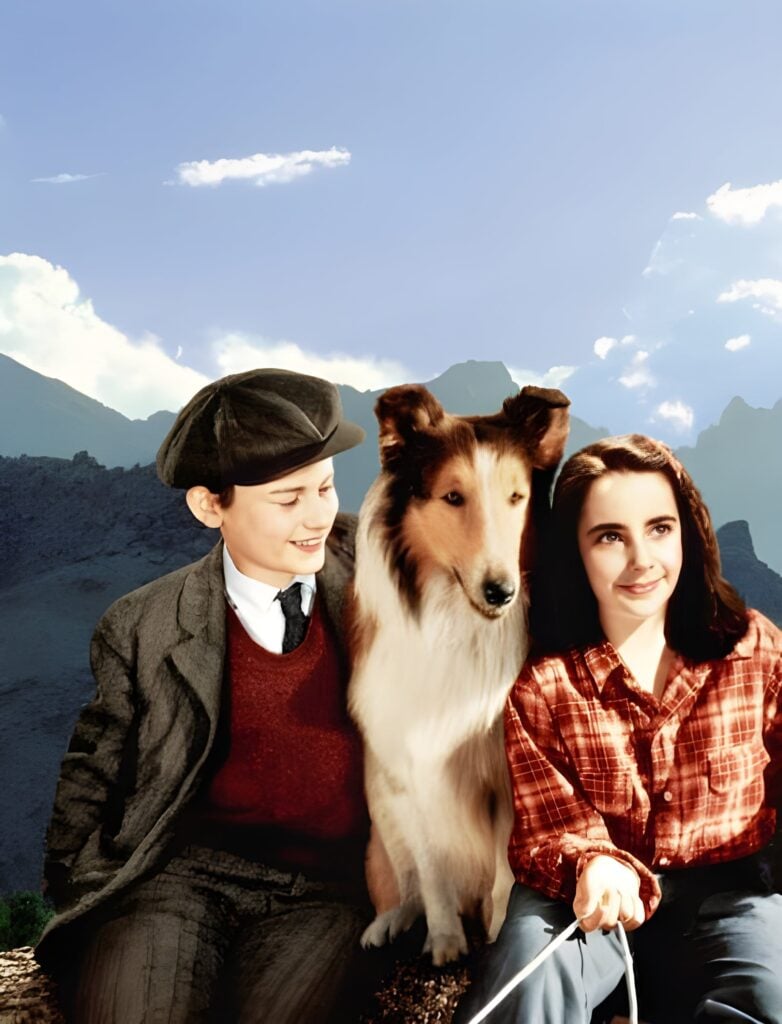
Pal was nobody’s idea of a movie star. According to Encyclopedia.com‘s history of the character, Weatherwax had taken the young, nonpedigreed collie in place of a training fee, and when MGM went looking for its Lassie, the studio wanted a show dog. “The studio had chosen a blow-dried best-in-show beauty to play Lassie,” NPR’s Ketzel Levine reported in a 2008 profile, “and this after scouring the country for the right look.” Pal was hired only as the stunt double, and his looks were thought to be spoiled by what one account called “an ugly white blaze running down the forehead.”
Then the script sent Lassie into a river. The female star balked, Pal went in, and he played the scene so well that the footage changed the casting. “When Louis B. Mayer saw the rushes, he informed the studio to fire the show dog and hire this unwanted, unpedigreed collie named Pal,” Lassie historian Ace Collins told NPR. “And Pal became Lassie.” The line that followed him for the rest of his life is credited to director Fred M. Wilcox in David Rothel’s book Great Show Business Animals: “Pal jumped into that river, but it was Lassie who climbed out.”
Not every version agrees on what doomed the first dog. Other accounts, including a 1992 Parade piece cited by Wikipedia, say she was let go because she shed so heavily during the summer shoot. Hold on to that detail, because Weatherwax certainly did.
What Did Weatherwax Shout From The Riverbank?
The finished film shows a soaked, exhausted Lassie dragging herself onto the bank and collapsing. Animal trainer Karl Miller, who worked with Weatherwax and later supervised the animals in Babe, told NPR in 2006 that the soundtrack behind the camera told a different tale. “Pal, jump! Jump! Get in there! Jump! Let him go! Atta boy! Swim across. Swim, swim! Atta boy,” Miller recalled, doing his best Weatherwax.
If Pal drifted left, Weatherwax ran right along the shore, waving and yelling until the dog hit his mark and dropped. “Director said, cut. We got it. Let’s move on,” Miller said, “and Rudd had to take a three-hour break.” The dog America would cry over for decades was being called “atta boy” on every take, which is about as plain an answer to the boy-or-girl question as you will find.
Pal went on to play Lassie in six more MGM pictures through The Painted Hills in 1951. When MGM was finished with the character, the Lassie name ended up with Weatherwax, and that set up the next chapter on television.
Who Played Lassie Opposite Jeff And Timmy?
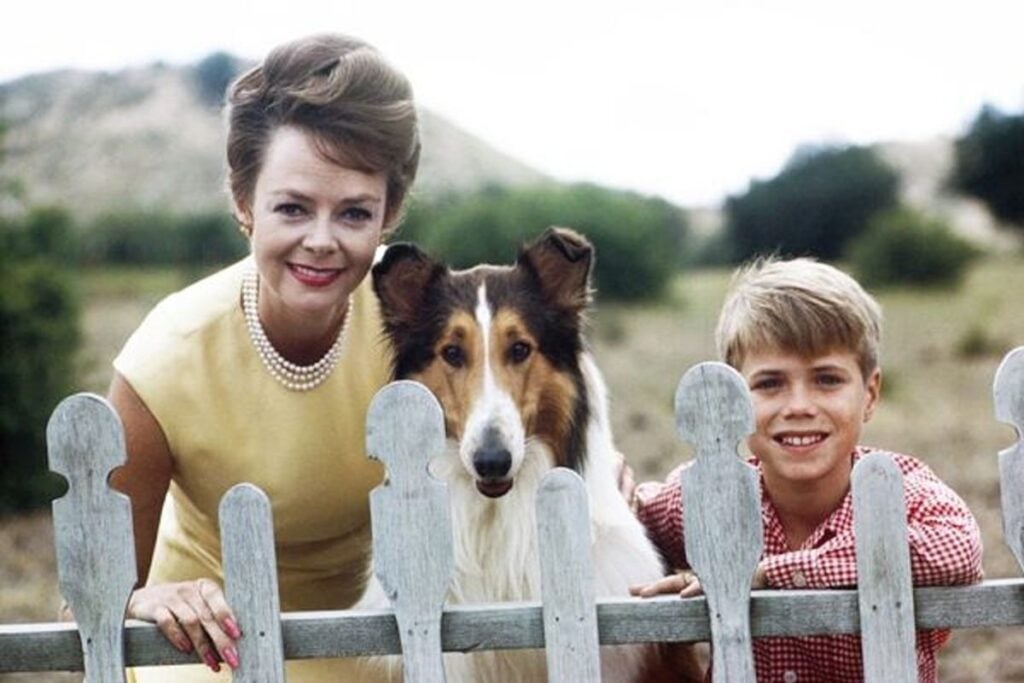
Pal appeared in the TV pilots, but by 1954 he had been working for 11 years. Mental Floss reports that his three-year-old son, Lassie Junior, “stepped in to pick up the family business,” and Lassie Junior carried the early seasons opposite Tommy Rettig as Jeff Miller. Pal retired to Weatherwax’s home in North Hollywood, where he died on June 18, 1958, at 18. “It hit him very hard when Pal died,” Rudd’s son later said, according to Mental Floss.
When Jon Provost arrived as Timmy Martin in 1957, the dogs were still Pal’s family. Provost, now 76, told an interviewer in 2014, “I worked with Baby for five years straight,” and the boy and Pal’s grandson grew up side by side through 1964, with June Lockhart playing his TV mother from 1958. Provost has always had a sense of humor about his character’s knack for trouble. “Timmy was a great kid but, boy, he was slow,” he told NPR. “If he didn’t have that dog, he would not be here today.”
That dog, of course, was a he. Which leaves the question fans have asked ever since they learned it: with plenty of lovely female collies in the world, why did the job never go to one?
Why Did Every Lassie Have To Be A Boy?

The answer is mostly about the coat. Collies shed heavily, and productions shot through the summer, which is exactly when a coat thins out. According to the Chicago Tribune, as cited by Remind Magazine, the males simply looked better on camera and lost less of that famous ruff in the hot months, and The New York Times pointed to the same shedding problem. A full-coated male also simply stood bigger beside a child actor.
Provost heard the reasoning straight from the man who knew best. In a 2020 conversation on trainer Annie Grossman’s podcast, he passed along what Weatherwax had told him. Some people said males were smarter and easier to train, he said, but that was not the real reason. “The males were larger, more colorful in the animal kingdom,” Provost explained, and the females had a problem no trainer could work around: “when the females come into heat, they lose their coat, and they don’t want to work.”
So the line stayed male for generations. Rudd Weatherwax’s son Bob, who apprenticed on the original series and took over as Lassie’s trainer after his father died in 1985, kept Pal’s descendants working in film and television for decades before his death on August 15, 2024, at 83, as The Hollywood Reporter and TheWrap reported. Provost, who called Baby “a special dog” on that same podcast, never pretended the name fit the actor. “Obviously Lassie is a female,” he told Grossman. “If it was a male would be Laddie.”


 86-Year-Old Tom Jones Announces Homecoming Shows After The Hospital Stay He Feared Was The End