
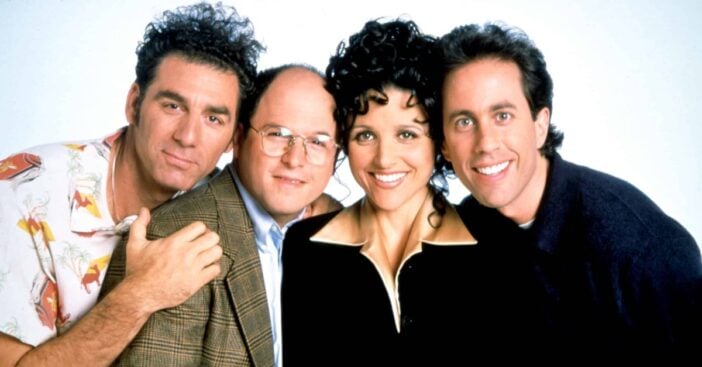
For nine seasons of Seinfeld, Cosmo Kramer slid through Jerry’s door as if he had nowhere else to be, and in all that time he never once seemed to be late for a shift. Viewers have been asking the obvious question since 1989. How did the man across the hall pay for anything?
The truth is that the show never gave Kramer a steady paycheck. He landed a few jobs that rarely outlived a single episode, and he chased dozens of schemes that went nowhere. The only big payday the series ever confirms arrives in the ninth season, when a Hollywood studio options his coffee table book about coffee tables, and he grandly announces his retirement.
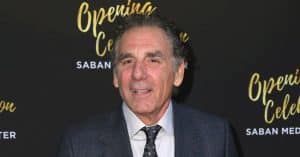
Meet Michael Richards

Seinfeld ran on NBC from 1989 to 1998, and Michael Richards, born July 24, 1949, and now 77, spent every one of those years as Jerry’s neighbor across the hall. Kramer wasn’t pure invention, either. Larry David borrowed him from a real man, Kenny Kramer, his former neighbor at Manhattan Plaza in New York.
Hold on to that coffee table book, because it is the only windfall the show ever puts on the record. It finally paid off in “The Wizard,” which aired in 1998.
What Jobs Did Kramer Actually Hold?
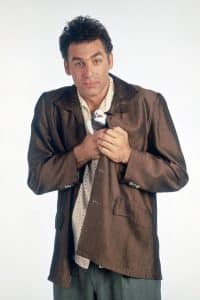
The closest thing Kramer had to a career came in “The Strike,” which aired December 18, 1997. It turned out he had been on strike from H&H Bagels for 12 years, and when a minimum wage increase finally settled the dispute, he went back to work. Then his boss refused him time off to celebrate Festivus, and the job did not survive the episode.
His strangest job paid nothing at all, which was exactly how he wanted it. In “The Bizarro Jerry” (October 3, 1996), Kramer wanders into the offices of Brand/Leland, gets mistaken for an employee, and starts showing up every morning by nine. “I don’t want any pay,” he tells Jerry, according to the episode’s script. When Mr. Leland finally lets him go, Kramer protests that he doesn’t even really work there, and Leland answers, “That’s what makes this so difficult.”
Show business didn’t pay off either. In “The Alternate Side” (December 4, 1991), a Woody Allen film crew hands Kramer a single line, “These pretzels are making me thirsty,” and he loses the part after a mishap on set injures Allen. That storyline came from Larry David’s own life, since he had played small parts in Allen’s films Radio Days and New York Stories.
And then there was “The Pool Guy” (November 16, 1995). Kramer’s new phone number is one digit away from Moviefone, so instead of changing it, he starts reading showtimes to callers in a robotic voice. He never charges a cent, and eventually the real Mr. Moviefone tracks him down.
Not every Kramer venture was a job, though. A few of them looked, at least to Kramer, like real businesses.
Which Kramer Schemes Never Made A Dime?
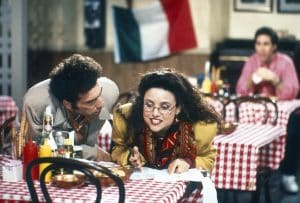
The big ideas all ran through Kramerica Industries. In the ninth season episode “The Voice,” Kramer recruits Darin, an intern from New York University, to help develop a rubber bladder system that would keep oil tankers from spilling. Their test involves dropping an oil-filled ball out of a window, and when it lands on a woman waiting below, the internship ends badly for everyone.
The bra for men in “The Doorman” (February 23, 1995) got further than most. Kramer and Frank Costanza build a prototype and pitch it to a bra salesman named Sid Farkus, but the partners can’t agree on a name. Kramer wants to call it “the Bro,” while Frank insists on “the Manssiere,” and the deal collapses when Frank storms out over Farkus dating Estelle. According to the episode’s production history, the naming fight echoed a real one in the writers’ room, where Tom Gammill and Max Pross used “the Bro” in the script and Larry David thought the other name was funnier.
Other ventures cost Kramer money instead of making it. In “The Merv Griffin Show” (November 6, 1997), he pulls the old talk show set out of a dumpster and starts hosting guests in his apartment, and because the real set had been destroyed decades earlier, the crew had to build a replica from archival photos. In “The Chicken Roaster” (November 14, 1996), a Kenny Rogers Roasters sign keeps him awake all night. He goes to war with the restaurant and ends up hooked on its chicken.
One deal did put something of value in his hands, and it came from a lawsuit.
Did Kramer Get Rich From The Java World Lawsuit?

In “The Maestro,” written by Larry David and aired October 5, 1995, Kramer burns himself with Java World coffee and hires the lawyer Jackie Chiles. The coffee chain is eager to settle, and its representative opens with an offer of “all the free coffee you want in any of our stores throughout North America and Europe, plus…” Before the man can finish, Kramer shouts “I’ll take it!”
Chiles is beside himself in the cab afterward. “I don’t want free coffee,” he tells Kramer. “It’s not hard to get coffee.” What he wanted to hear was whatever came after the word “plus,” but Kramer insists he never heard it, so the settlement was coffee and nothing else.
The payday Kramer finally got came from an idea he had dreamed up two years earlier.
How Did A Coffee Table Book About Coffee Tables Pay Off?

The idea first surfaces in “The Cigar Store Indian” (December 9, 1993), when Kramer pitches “a coffee table book about coffee tables” to Elaine. She has no intention of passing it along, so Kramer takes it straight to her boss, Mr. Lippman at Pendant Publishing, and Elaine ends up assigned to the project.
The launch went about as well as you would expect. In “The Opposite” (May 19, 1994), Kramer goes on Live with Regis and Kathie Lee to show off the book’s fold-out legs, then spits a mouthful of coffee onto Kathie Lee. The book tour is canceled, and Pendant goes out of business.
Four years later, in “The Wizard” (February 26, 1998), the book came back to life. “A big Hollywood so-and-so optioned it for a movie,” Kramer tells the gang. Asked how much they paid him, he answers, “Let’s just say that I don’t have to worry about working for a while. A long while.” Then comes the grand announcement, “Boys, I’m retiring,” followed by the perfect Kramer qualifier, “From the grind.” He moves to Del Boca Vista in Florida and runs for condo board president, and after losing the election, he moves right back to New York.
That still leaves eight seasons of rent the show never explains, and fans have happily filled in the gap themselves.
What Do Fans Think Paid Kramer’s Rent?
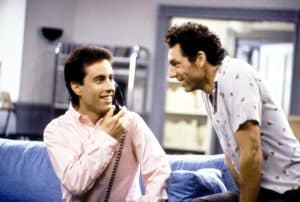
The writers were in on the joke. In “The Visa” (January 27, 1993), Kramer is off at a baseball fantasy camp, and George can’t let it go. “Kramer goes to a fantasy camp,” he says. “His whole life is a fantasy camp.” People should pay $2,000, George adds, to live like Kramer for a week, doing nothing and stumbling into money.
One popular fan theory holds that Kramer had a cheap, rent-controlled apartment, though the show never says so. Another points to gambling, because in “The Diplomat’s Club” Kramer bets a wealthy Texan on airline arrival times, and some fans count that as proof of a side income. Neither theory comes from the writers.
The best clue of all lives outside the show, with the man Kramer was named after.
What Did Larry David Say About The Real Kramer?
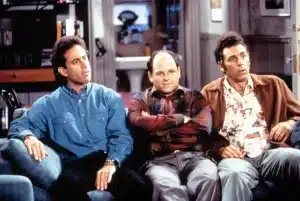
Long before Seinfeld, Larry David lived across the hall from Kenny Kramer at Manhattan Plaza, a federally assisted building for performing artists in Hell’s Kitchen. In a featurette about the making of the series, quoted by Slashfilm, David remembered him as “a guy who didn’t work, really, or if he did nobody really knew what he did.” Then he added the detail that explains everything: “What I knew is that he was in that apartment 22 out of the 24 hours of the day.”
So the missing paycheck was never a plot hole. It was the whole idea from the start, and Kenny Kramer seemed to enjoy it. “I have achieved this without actual accomplishment,” he told the Chicago Sun-Times in 1998.
Still, the real Kramer eventually found the steady income his TV double never had. In 1996 he launched Kramer’s Reality Tour, a three hour bus ride past New York spots tied to Seinfeld stories, and the show answered him in “The Muffin Tops” (May 8, 1997), when Kramer starts a Peterman Reality Tour on a school bus and charges $37.50 a seat. According to the Chicago Sun-Times and Boca Magazine, that was the price of Kenny Kramer’s real tour, too.
As for the man who made us laugh every time that door flew open, Michael Richards, now 77, has largely stepped away from public life since his 2024 memoir Entrances and Exits. When Parade reported a rare sighting of him in West Hollywood in May 2026, it was his first public outing in nearly two years. If you miss the old gang as much as we do, you can catch up with them in our story on the rare Seinfeld reunion with Jerry Seinfeld, Julia Louis-Dreyfus, and Larry David.