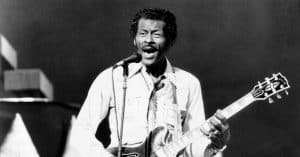

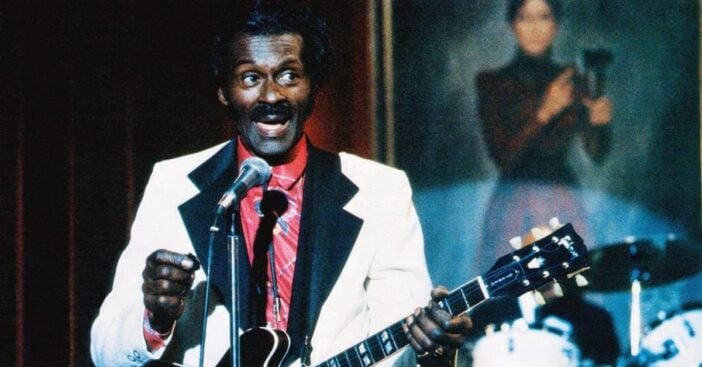
Charles Edward Anderson Berry was born in St. Louis on October 18, 1926. Today would have been his 100th birthday. The man fans still call the Father of Rock and Roll died at his Missouri home on March 18, 2017, at age 90.
Of all the rockers who borrowed from him, Bruce Springsteen may have put the debt most plainly. “I wanted to write the way I thought people talked. That’s the way he writes,” Springsteen said, as quoted this month by The Philadelphia Inquirer. When Berry died, Springsteen called him “the greatest pure rock ‘n’ roll writer who ever lived,” according to NJArts.net.
One Beatle borrowed a little too directly. A single line lifted from a Chuck Berry record put John Lennon in a New York courtroom, and the fight shaped one of his best-loved albums.
Which Song Started It All For Chuck Berry?

Chess Records released “Maybellene” in 1955. It sold more than a million copies and reached No. 1 on the Billboard rhythm and blues chart. White teenagers bought it too, and it climbed to No. 5 on the pop side.
The hits that followed spoke straight to young listeners about cars, school bells and first dances. “Roll Over Beethoven” and “Sweet Little Sixteen” came next, and then “Johnny B. Goode.” In 1986 Berry joined the very first class inducted into the Rock and Roll Hall of Fame.
One of those songs has traveled farther than any other. “Johnny B. Goode” is the only rock and roll track on the Golden Record that NASA sent into space aboard the Voyager probes in 1977. Nearly 50 years later, his story of a country boy who could play a guitar just like ringing a bell is still sailing through interstellar space.
Who Is Still Celebrating Chuck Berry At 100?
The Bruce Springsteen Center for American Music at Monmouth University marked the centennial early. On October 10, it held a daylong symposium called “Chuck Berry at 100” at the Pollak Theatre in West Long Branch, New Jersey.
Biographer RJ Smith, author of Chuck Berry: An American Life, gave the keynote. Panels covered the birth of rock and roll and the way Berry’s playing shaped the electric guitar. Guest musicians closed the day with a concert of his songs.
John Lennon once said that if you tried to give rock and roll another name, you might call it Chuck Berry. The Beatles and the Rolling Stones both recorded his songs early on. Lennon knew those records by heart, and that is where the trouble began.
Which Beatles Song Borrowed From Chuck Berry?

When the Beatles released “Come Together” in 1969, the opening line, “Here come old flat-top,” came straight from Chuck Berry’s 1956 song “You Can’t Catch Me.” Paul McCartney caught it in the studio. “I pointed out to him that it was very similar to Chuck Berry’s ‘You Can’t Catch Me,'” he recalled, according to uDiscover Music.
Lennon did not deny it. “‘Come Together’ is me, writing obscurely around an old Chuck Berry thing,” he told David Sheff in 1980 for Playboy, as uDiscover Music and Today I Found Out both noted.
Berry did not sue. The man who owned the copyright did. Music publisher Morris Levy, whose Big Seven Music held “You Can’t Catch Me,” took Lennon to court a few months after Abbey Road came out, Today I Found Out reported.
How Did One Line Land John Lennon In Court?
The case settled in New York on October 12, 1973, according to The Beatles Bible. Lennon agreed to record three songs owned by Levy’s company on his next album.
His next album was Walls and Bridges in 1974. It held just one Big Seven song, a brief take on “Ya Ya” with his 11-year-old son Julian on drums, both sources reported. Levy saw that as a breach. He met with Lennon in Manhattan that October and left believing he could sell an oldies album by mail order. “My policy all the time is whenever they get into figures or business, I just tune out,” Lennon said later, as The Beatles Bible recounted.
The oldies album had its own troubles. Producer Phil Spector had walked off with the master tapes, and Capitol Records paid about $90,000 to get them back, Salon and Today I Found Out reported. Lennon had shared a rough mix with Levy. In February 1975, Levy put it out on his TV mail-order label, Adam VIII, as Roots: John Lennon Sings the Great Rock & Roll Hits.

Capitol released the official version. That deal became his 1975 album Rock ‘n’ Roll, a tribute to the songs he grew up on, including “You Can’t Catch Me” itself, Today I Found Out reported. Levy sued again, and Lennon countersued over the unauthorized Roots.
The case went to trial in federal court in Manhattan. On February 20, 1976, Judge Thomas Griesa rejected Levy’s main claims, The Beatles Bible reported. Levy was awarded about $7,000 for breach of an oral agreement. Lennon and his labels were awarded roughly $110,000 in lost income, plus punitive damages, both sources reported. Berry’s song got a second life.
Years later, Lennon was still shrugging off the original case. “It is nothing like the Chuck Berry song,” he told Playboy in 1980, “but they took me to court because I admitted the influence once years ago.”