

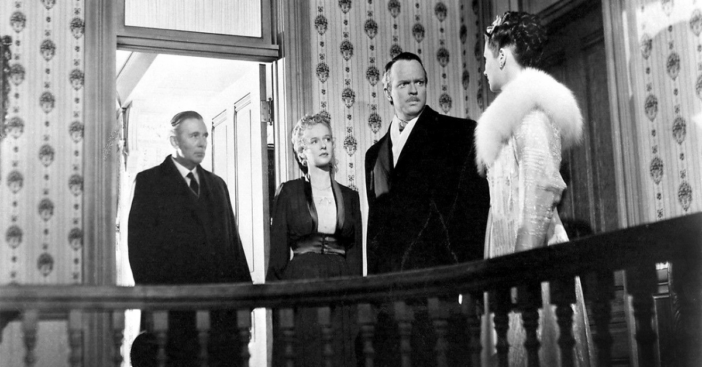
Charles Foster Kane dies alone in his enormous Florida mansion with a snow globe slipping from his hand, and the last word he breathes is “Rosebud.” Orson Welles was only 25 when he made Citizen Kane, which premiered at New York’s Palace Theatre on May 1, 1941, and that whispered word sends a newsreel reporter named Thompson chasing Kane’s old friends, his ex-wife and his butler for the rest of the picture. Nobody he talks to can tell him what it means.
The audience gets the answer that Thompson never does. In the final minutes, workers clearing out a warehouse of Kane’s treasures toss a child’s wooden sled into a furnace, and as the paint blisters, the name on it comes into view: Rosebud. It is the sled young Charlie was riding in the Colorado snow on the day his mother sent him away to be raised by a banker, the last afternoon of his childhood. That is the short answer. The longer one involves a feud with the most powerful publisher in America, a rude piece of Hollywood gossip that refuses to die, and a director who came to wish he had never used the word at all.
Whose Idea Was Rosebud in the First Place?
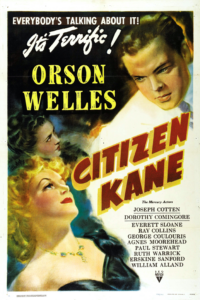
The word came from the typewriter of Herman J. Mankiewicz, the witty, hard-drinking screenwriter who wrote the first drafts of the script with Welles and later shared the film’s only Oscar with him, for Best Original Screenplay. Mankiewicz knew the world he was writing about. He had been a friend of actress Marion Davies, which put him at the parties of her longtime companion, newspaper baron William Randolph Hearst.
Where Mankiewicz found the word is its own little mystery. His biographer Richard Meryman wrote that the real emotional source was a bicycle Mankiewicz treasured as a boy, which was stolen and never replaced. Film historian Patrick McGilligan reported in 2015 that Mankiewicz traced the name to a racehorse, Old Rosebud, which he bet on to win the 1914 Kentucky Derby. The horse won. McGilligan wrote that “Old Rosebud symbolized his lost youth, and the break with his family.” Welles, for his part, was happy to hand Mankiewicz the credit, and as it turned out, he had his reasons.
Why Did William Randolph Hearst Want the Film Destroyed?

Anyone who saw Citizen Kane in 1941 could see the parallels. Kane is a newspaper tycoon who builds a castle stuffed with art and statues, much like Hearst’s estate at San Simeon, and he pushes an untalented young singer named Susan Alexander into a career she does not want. Many readers took Susan as a portrait of Davies, whose film career Hearst bankrolled for years.
Hearst’s gossip columnist Louella Parsons demanded a private screening in January 1941 and sat through it with two Hearst lawyers beside her. By one witness’s account, she walked out. What followed was a full campaign. Hearst’s papers refused to print ads for the film or even mention it, and according to PBS’s American Experience, the effort reached theater owners who were pressured to keep the picture off their screens. The strangest offer came from inside Hollywood. Nicholas Schenck, whose company owned MGM, told RKO that Louis B. Mayer and other studio chiefs would repay roughly the $800,000 the film had cost if RKO would destroy the negative and every print. RKO said no and the movie opened anyway, but with so many theaters shut against it, it lost money on its first run.
Was “Rosebud” Really Hearst’s Private Nickname?
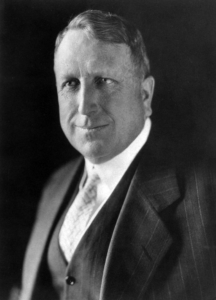
This is where the story turns from history into gossip, so it is worth being careful. In a 1989 essay in The New York Review of Books, the novelist Gore Vidal wrote that “Rosebud was what Hearst called his friend Marion Davies’s clitoris.” The same rumor had floated around Hollywood for years, and it would explain a great deal of Hearst’s fury if it were true.
The trouble is that nobody has ever produced proof. When a reader named Jay Topkis challenged Vidal in the magazine’s letters page, he pointed out that only two people could have known Hearst’s pet names and that Vidal named neither as his source, leaving the story resting on “Mr. Vidal’s ipse dixit.” In reply, Vidal admitted that he had met Hearst and Davies but never asked either of them. He suggested the detail could have traveled through Davies’s party circle, and he noted that Frank Brady’s biography of Welles repeats the story, though Brady himself called it “highly unlikely.” So the nickname remains a claim, passed from writer to writer, with no letter, diary or firsthand witness behind it. Welles, notably, never confirmed it.
He did take pains to defend Davies. In his 1975 foreword to her memoir, The Times We Had, Welles insisted that Susan Alexander bore Davies “no resemblance at all,” adding, “The wife was a puppet and a prisoner; the mistress was never less than a princess.”
What Did Orson Welles Really Think of His Famous Ending?
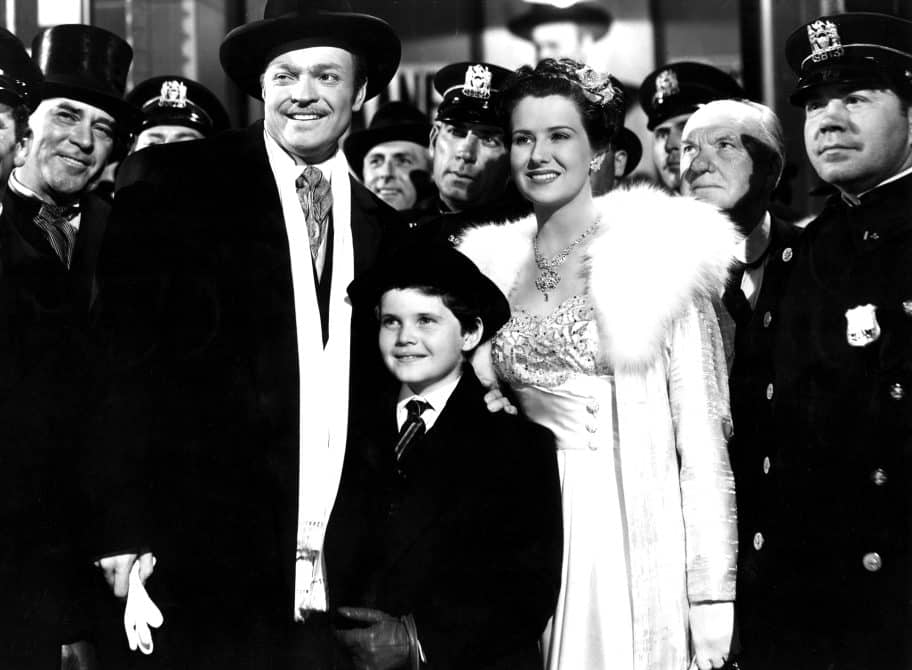
For a man whose name is welded to that sled, Welles was remarkably unsentimental about it. In a 1960 interview filmed in Paris for the CBC program Close-Up with host Bernard Braden, he was asked about the device and did not hold back. “I’m ashamed of Rosebud,” he said. “I think it’s a rather tawdry device. It’s the thing I like least in Kane.” Then came the line that film students still quote: “It’s kind of a dollar book Freudian gag. It doesn’t stand up very well.” Smithsonian magazine has reported the same verdict, that Welles hated the gimmick and credited it to Mankiewicz.
What the film itself says is gentler than Welles gave it credit for. Thompson never finds the answer, and in his last scene he shrugs at the whole hunt. “I don’t think any word can explain a man’s life,” he tells the other reporters, calling Rosebud a missing piece of a jigsaw puzzle. The furnace shows us what he missed. Kane had every statue and newspaper money could buy, and the thing he reached for at the end was a cheap sled from the one stretch of his life when he was simply a boy in the snow. If you first saw it on late-night TV, you probably remember the hush in the room when that paint started to burn.
What Happened to the Real Rosebud Sleds?
Several sleds were built for the shoot, including three balsa versions made to be burned. According to Wellesnet, Welles was satisfied after the second one went into the flames, so the third was never needed and went into storage at RKO. Years later a studio watchman found it on a trash heap outside the old prop vault, and RKO archivist John Hall bought it from him.
That leftover sled went up for sale at Sotheby’s in June 1982, and the winning bid of $60,500 came from Steven Spielberg, in the same summer E.T. hit theaters. He called the sled “a symbolic emblem of quality in the film business” and hung it in his office for decades. Spielberg, now 79, later said it “really belongs in a museum so everybody can see it,” and he gave it to the Academy Museum of Motion Pictures in Los Angeles, which opened in 2021. A separate pine sled, awarded to a 12-year-old boy named Arthur Bauer in a 1942 RKO contest, spent years as a plant stand before selling at Christie’s in 1996 for $233,500.
The biggest surprise came in the summer of 2025. Director Joe Dante, now 79, had been handed a wooden Rosebud sled by a crew member clearing out props on the Paramount lot while he was making Explorers in the 1980s. “They’re throwing out all of this stuff. You might want this,” he recalled being told. In July 2025, Smithsonian magazine reported that it sold at Heritage Auctions for $14.75 million, second only to Dorothy’s ruby slippers among movie props. Welles called his Rosebud a cheap gag. Eighty-four years after the film opened, a child’s sled with that one word painted across it became one of the most valuable props Hollywood ever made, and the little boy in the snow finally got the last word.