

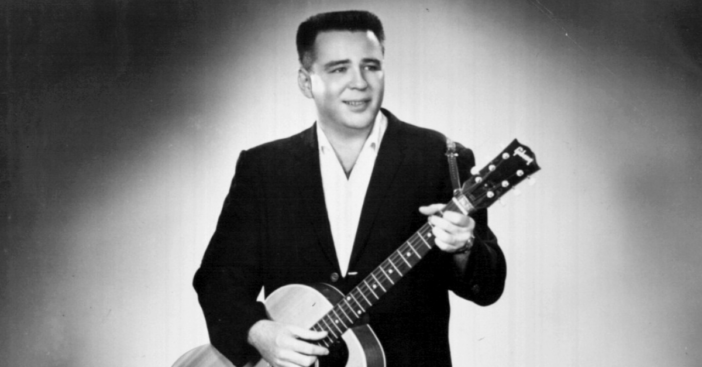
J.P. Richardson was born on October 24, 1930, in Sabine Pass, Texas, which means he would have turned 96 this Saturday. Most of us knew him by the booming “Hello, baby!” that opened “Chantilly Lace,” and by the terrible night in February 1959 when he died in an Iowa cornfield alongside Buddy Holly and Ritchie Valens. He was 28 years old, and his wife was expecting a baby.
That child was a boy, Jay Perry Richardson, born that spring. Nearly half a century later, Jay startled fans when he asked to have his father’s grave opened, because he wanted a scientist to tell him how the Big Bopper really died.
How Did A Beaumont Disc Jockey Become The Big Bopper?
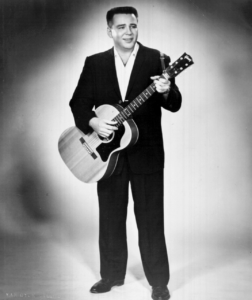
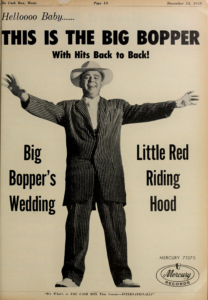
Before he was a recording star, Richardson was the afternoon voice of KTRM radio in Beaumont, Texas, where he went full time in 1949 and returned after a stint in the Army. He borrowed his on-air name from college kids doing a dance called the Bop. In May 1957 he stayed on the air for more than five days straight and played 1,821 records, a continuous broadcasting record at the time. A year later Mercury Records released “Chantilly Lace,” his playful one-sided phone call with a girl in a “pony tail hangin’ down,” and it climbed to No. 6 on the pop chart and sold more than a million copies.
Some of his best songs made other men famous. He wrote “White Lightning,” which became George Jones’s first No. 1 country hit in 1959, and he wrote “Running Bear” for his friend Johnny Preston. Preston’s record went to No. 1 in January 1960, almost a year after the man who wrote it was gone.
Why Was The Big Bopper On That Plane?
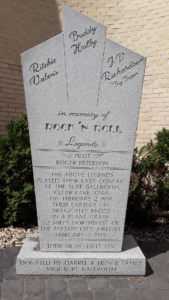
The Winter Dance Party tour opened on January 23, 1959, and the musicians crossed the frozen Midwest in buses with failing heaters. By the time they reached the Surf Ballroom in Clear Lake, Iowa, on February 2, Holly had chartered a small plane to fly ahead to the next stop. Richardson was a big man and he was fighting the flu, so Holly’s bass player Waylon Jennings gave him his seat. Guitarist Tommy Allsup lost his own seat to Valens on a coin toss.
Jennings never forgot what came next. As he recalled it, Holly teased him with “Well, I hope your ol’ bus freezes up again,” and Jennings shot back, “Well, I hope your ol’ plane crashes.” It was ordinary road ribbing, and Jennings carried that line for the rest of his life.
The Beechcraft Bonanza left the Mason City airport shortly before 1 a.m. on February 3 with 21-year-old pilot Roger Peterson at the controls. It went down in a field a few miles away and killed all four men aboard. Holly was 22, and Valens was only 17. Don McLean would later call it “the day the music died” in “American Pie,” a song fans still decode line by line, as in our look at who the jester in “American Pie” really is. Richardson’s body was found apart from the others, roughly 40 feet from the wreckage, and that one detail would trouble his family for decades.
Why Did His Son Want Him Exhumed?
When the snow melted that spring, a farmer found Buddy Holly’s .22 pistol near the crash site, and newspaper reports of the find started talk that a shot had been fired on board, even though the Civil Aeronautics Board blamed pilot error. Another story claimed that Richardson had survived the impact and crawled away to look for help, which would explain why he was lying so far from the plane.
Jay grew up with those stories, and as a teenager he once called Waylon Jennings to learn about the man he never met. He later sang his father’s songs on tribute tours as the Big Bopper Jr. In January 2007 he announced he would have his father’s remains exhumed in Beaumont and examined by Dr. Bill Bass, the University of Tennessee forensic anthropologist who founded the Body Farm.
“I’m not looking for any great bombshell, but then again you never know,” Jay told the Associated Press, in a story carried by CBS News. “I don’t know how I would feel to know that my father died some other way than what I believed most of my life.” The timing had a practical side, since the family was already planning to move Richardson to a more prominent spot in Beaumont’s Forest Lawn Cemetery, beside his wife, with a life-sized statue at the grave. In March 2007, the coffin was opened.
What Did The Big Bopper’s Exhumation Reveal?
Jay stood beside Bass for the entire examination. Both men were surprised at how well preserved the remains were after 48 years, well enough that he was recognizable as the man Jay had only seen in photographs. Bass took X-rays, which would have shown the lead fragments a bullet leaves behind, and he found nothing to support either rumor.
What he found instead were injuries from a single, violent moment. “There are fractures from head to toe. Massive fractures,” Bass told reporters, as the AP reported. “There was no indication of foul play,” he added, concluding that Richardson died instantly. “He didn’t crawl away,” Bass said. “He didn’t walk away from the plane.”
For Jay, the answer brought peace instead of a bombshell. “Dad still amazes me 48 years after his death, that he was in remarkable shape,” he told the AP. “I surprised myself. I handled it better than I thought I would.” His father was laid to rest again next to his mother at Forest Lawn, in a new casket made by the same company as the first.
Jay went back to singing his father’s songs on stage, and when he died in 2013, the questions he had carried since boyhood had been answered at his father’s graveside.