

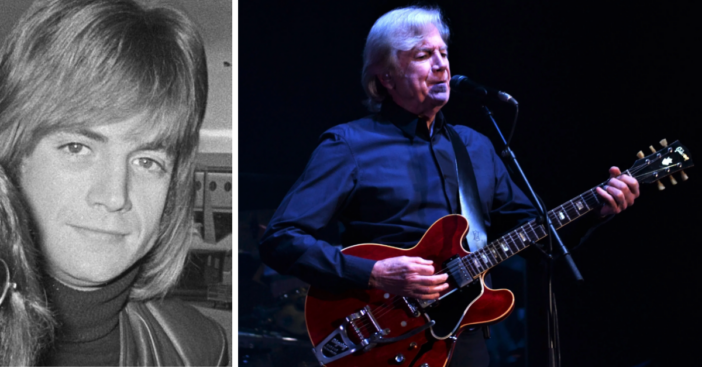
Justin Hayward turns 80 on October 14, and the voice behind “Nights in White Satin” carries a bittersweet distinction now. He is the last surviving member of the Moody Blues’ classic lineup. Born in Swindon, England, in 1946, Hayward joined the band in 1966 and became its frontman, guitarist, and principal songwriter almost at once.
Hayward actually joined a band that had already tasted chart success. The Moody Blues scored a major hit in 1964 with “Go Now,” featuring original lead singer Denny Laine, who later joined Paul McCartney’s Wings. By the time Hayward and bassist John Lodge arrived in 1966, the group was ready to move beyond its rhythm-and-blues roots. The new lineup, which also included Mike Pinder, Ray Thomas, and Graeme Edge, soon developed the lush, experimental sound that would define the Moody Blues for generations.
The milestone arrives less than a year after the band lost another of its own.
Justin Hayward Gave The Moody Blues Their Voice
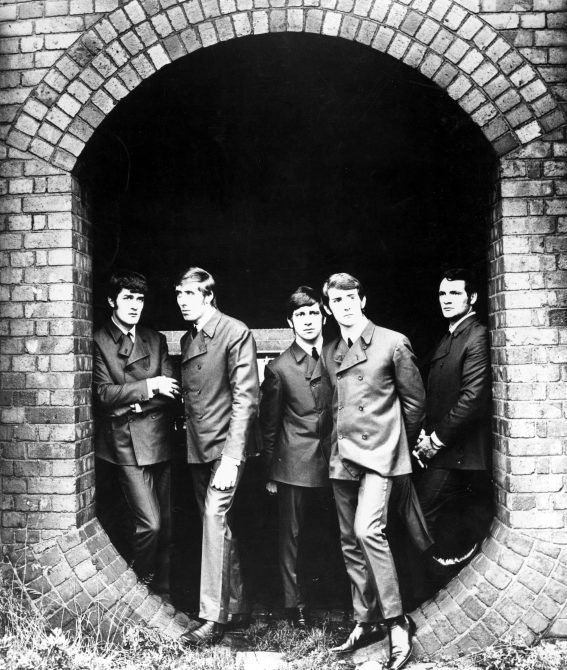
He wrote “Nights in White Satin,” “Tuesday Afternoon,” and “Question,” songs that fused rock with orchestral sweep and helped invent a whole lush corner of the genre. The Moody Blues were inducted into the Rock and Roll Hall of Fame in 2018, a recognition fans felt was long overdue.
Perhaps the most remarkable part of “Nights in White Satin” is that Hayward was only 19 when he wrote it. He has recalled returning home from a concert in 1967, sitting on the edge of his bed with a 12-string guitar, and writing the song while navigating the end of one relationship and the beginning of another. When he first played it for his bandmates, they were hardly enthusiastic. Everything changed when keyboardist Mike Pinder began adding the sweeping sounds of his Mellotron, an instrument that could imitate an orchestra. Suddenly, the song had the unmistakable sound that would help make the Moody Blues famous.
Even then, “Nights in White Satin” wasn’t an immediate American smash. First released on the band’s 1967 album Days of Future Passed, the song didn’t reach its greatest commercial success in the United States until 1972, when it climbed to No. 2 on the Billboard Hot 100. Hayward has admitted that the delayed success surprised him, especially because the record’s length and unusual arrangement made it an unlikely radio single. He later described that second chance as a turning point that changed the lives of everyone in the band.
The Last One Standing
Hayward and Lodge shared a particularly important musical partnership that extended beyond the Moody Blues. When the group took a hiatus in the mid-1970s, the two recorded the 1975 album Blue Jays, which included the songs “Remember Me (My Friend)” and “I Dreamed Last Night.” Hayward also found success with “Blue Guitar,” recorded with members of 10cc. Their collaboration helped keep the Moody Blues’ distinctive sound alive during the band’s absence, and the two eventually reunited with their bandmates for the 1978 album Octave.
Ray Thomas died in 2018, Graeme Edge in 2021, and Mike Pinder in 2024, a loss we marked when the band’s Mike Pinder passed at 82. Bandmate John Lodge died on October 10, 2025, almost exactly a year before this birthday, leaving Hayward alone to carry the songs. His career record traces the whole journey. At 80 he is still touring, still singing those satin nights.
Eighty years old, and the voice has not aged a day.