

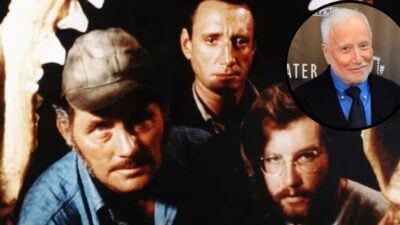
Richard Dreyfuss turns 79 on Thursday, October 29. He was born that day in 1947 in Brooklyn, and more than fifty years after Jaws, the question people still bring him is about the man who sat across the cabin table from him on the Orca. The story of Richard Dreyfuss and Robert Shaw has been told by Steven Spielberg, by Roy Scheider and even by Shaw’s own son in a Broadway play, and Dreyfuss has not always liked the way it gets told.
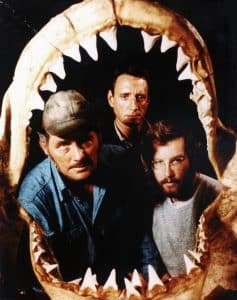
When cameras rolled off Martha’s Vineyard in May 1974, Dreyfuss was 26 and best known for American Graffiti. Shaw was nearly twenty years older, an Oscar nominee for playing Henry VIII in A Man for All Seasons and a prize-winning novelist besides. A shoot planned for 55 days dragged on for 159, and somewhere in those long months on the water the two men became the most talked-about pairing in the picture.
What Did Robert Shaw Do to Richard Dreyfuss on the Jaws Set?

Dreyfuss almost wasn’t there at all. George Lucas suggested him for the shark expert Hooper, and he first said no. Then he watched himself in The Apprenticeship of Duddy Kravitz and panicked. “I thought that I had given the worst performance in the history of celluloid,” he later told CBS News, so he called back and took the part. The irony is that the critics loved Duddy Kravitz, and those good reviews arrived while Shaw was stuck on a boat with the young man getting them.
Shaw needled him from the start. He reportedly called Dreyfuss “fat” and “sloppy,” and Spielberg has recalled the dares that followed. “Robert would basically humiliate Richard into taking a chance,” the director said, describing how Shaw offered Dreyfuss a hundred dollars to climb the Orca’s mast and jump into the sea. Roy Scheider, who watched it all as Chief Brody, said Shaw believed Dreyfuss needed “a slapping down” because he saw him as a young punk with no stage experience.
Drink was part of it too. Shaw struggled with alcohol for most of his life, and he was candid about it on set. “I do tend to drink when totally bored,” he told an interviewer during filming. “Roy does exercises, and Dreyfuss talks… just talks interminably.” Which leads to the day the teasing stopped being funny.
The Day Dreyfuss Lost His Sense of Humor

Screenwriter Carl Gottlieb wrote in The Jaws Log that Shaw announced one afternoon, “I wish I could quit drinking,” and Dreyfuss answered by throwing Shaw’s drink into the ocean. Spielberg called it “the shot heard around the world,” adding, “It got ugly.” In Dreyfuss’s version, Shaw paid him back by turning a hose on him, and he admits that one stung. “That was the only day I lost my sense of humor,” he told Vanity Fair in 2023, as reported by TheWrap. “That was not a feud.”
His own descriptions of Shaw have always carried two sides. In the 2010 documentary Jaws: The Inside Story, the same one where Spielberg coined the phrase “the great Shaw-Dreyfuss feud,” Dreyfuss said Shaw in private “was the kindest, gentlest, funniest guy you ever met.” But on the walk to the set, he added, “he was possessed by some evil troll, who would then make me his victim.”
Many viewers think you can see that friction on screen. Watch the night scene where Quint crushes a beer can in one fist and Hooper answers by crumpling a paper cup, or the moment the young scientist is told he has “city hands.” Writers at Collider and Screen Rant have both argued the real tension sharpened those exchanges. So how did the off-screen story get so big?
Why Richard Dreyfuss and Robert Shaw Still Make Headlines
Much of it came from Ian Shaw, Robert’s son, who co-wrote and starred as his father in The Shark Is Broken, a play drawn partly from his father’s diary that reached Broadway in 2023. “I went to see it, to see if it really was gonna hurt,” he told Vanity Fair. “And it did.” He said the writers “just decided to make my character a big jerk,” and that it hurt “because it wasn’t true.” DYR covered his reaction to the Broadway play about the Jaws shoot when it opened, and he has blamed Gottlieb and Spielberg for feeding the legend. “We never had any bad feeling between us, ever,” he insisted.
The rest of his career gave him plenty of other things to talk about. He followed Jaws with Close Encounters of the Third Kind for Spielberg in 1977, and that same year The Goodbye Girl won him the Best Actor Oscar at 30, then the youngest man ever to take that award. He earned a second nomination as a music teacher in Mr. Holland’s Opus in 1995, and our American Graffiti cast then and now shows where his old co-stars landed. Lately he has had rough patches. In May 2024, his remarks about women and diversity at a Jaws screening in Beverly, Massachusetts, led audience members to walk out and the Cabot theater to apologize, as CBS News and The Hollywood Reporter both reported. Yet the subject he returns to most warmly is Shaw.
What Richard Dreyfuss Finally Said About Robert Shaw
Robert Shaw died on August 28, 1978, of a heart attack while driving near his home in County Mayo, Ireland. He was 51. Dreyfuss was the one who carried the news to Spielberg. “I took that news and I drove over to Steven’s house,” he told The Daily Jaws in an interview published this January. “He was at the piano playing, and he did not respond to me when I spoke to him, because he couldn’t.”
In the same interview he spoke of Shaw in a way the feud stories never allow. “I’ve never had such a loss, ever,” he said. “None of us knew that we were going to feel so deeply, personally the loss of one of us.” In a Universal interview he called Shaw “a promethean character” and said he had “worshiped him” as a grand artist.
Before he died, Shaw had made him an offer. “I’ll play the ghost to your Hamlet,” Shaw told him, “if you play the fool to my Lear.” Dreyfuss said he would, but only in about ten years, “because you’ll blow me off the stage.” Shaw never got those ten years. Dreyfuss still calls the offer a sign of “a certain kind of trust” between them as actors, and that is the moment he chooses to remember, ahead of the hose and the whiskey and the dare on the mast.


 ‘Charlie’s Angels’ Star Kate Jackson Lost An Oscar-Winning Role Over A Schedule