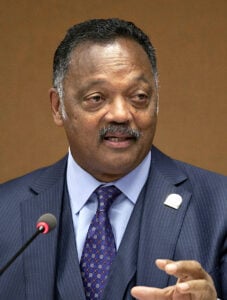

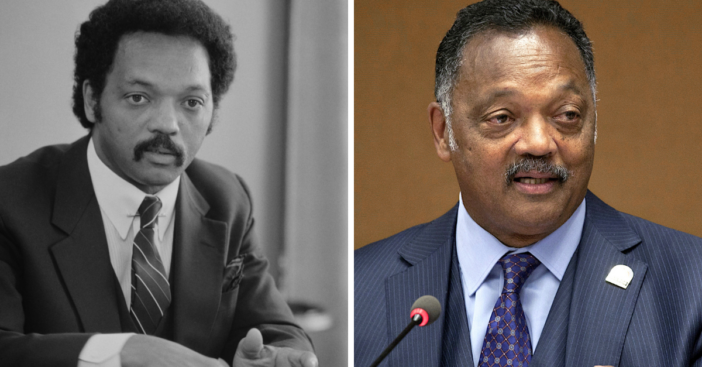
Reverend Jesse Louis Jackson Sr., a prominent civil rights leader, Baptist minister, and two-time Democratic presidential candidate, died on February 17, at the age of 84. His family announced that he died peacefully in Chicago, where he had spent much of his adult life working for racial justice and economic equality. Jackson was surrounded by family at the time of his death.
In a statement, the Jackson family described him as a “servant leader — not only to our family, but to the oppressed, the voiceless, and the overlooked around the world,” and asked that people honor his memory by continuing the fight for justice, equality, and love. He is survived by his wife, Jacqueline Jackson, whom he married in 1962, and six children.
The early life of Jesse Jackson
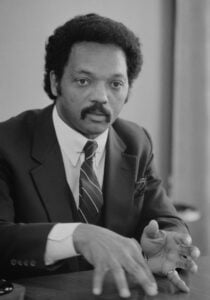
Jackson was born Jesse Louis Burns on October 8, 1941, in Greenville, South Carolina, in the segregated South. He grew up facing Jim Crow laws and discrimination, experiences that shaped his lifelong commitment to civil rights. He attended North Carolina Agricultural and Technical State University, became active in student protests against segregation, and was ordained a Baptist minister in 1968.
He became a national civil rights figure in the 1960s through his work with the Southern Christian Leadership Conference (SCLC) under Dr. Martin Luther King Jr., marching in major campaigns including the Selma to Montgomery march. In 1971, he founded Operation PUSH (People United to Save Humanity) in Chicago to advocate for economic and social justice for African Americans. He later established the National Rainbow Coalition, and in 1996 merged it with PUSH to form the Rainbow/PUSH Coalition.
Forging the future
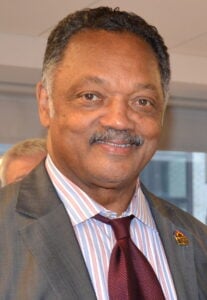
Jackson also made history in presidential politics. In 1984 and 1988, he ran for the Democratic nomination, becoming one of the first Black Americans to gain serious traction in a major party’s presidential contest. His 1988 campaign was particularly notable, as he won multiple primaries and caucuses — the most successful showing for a Black candidate at that time — and helped broaden the Democratic Party’s coalition.
In his later years, Jackson faced ongoing health challenges, including a Parkinson’s disease diagnosis and a subsequent diagnosis of progressive supranuclear palsy (PSP), a rare neurological disorder. He remained a public figure and advocate despite these struggles. His contributions to civil rights, voter registration, economic justice, and political representation left a lasting impact on American public life.